
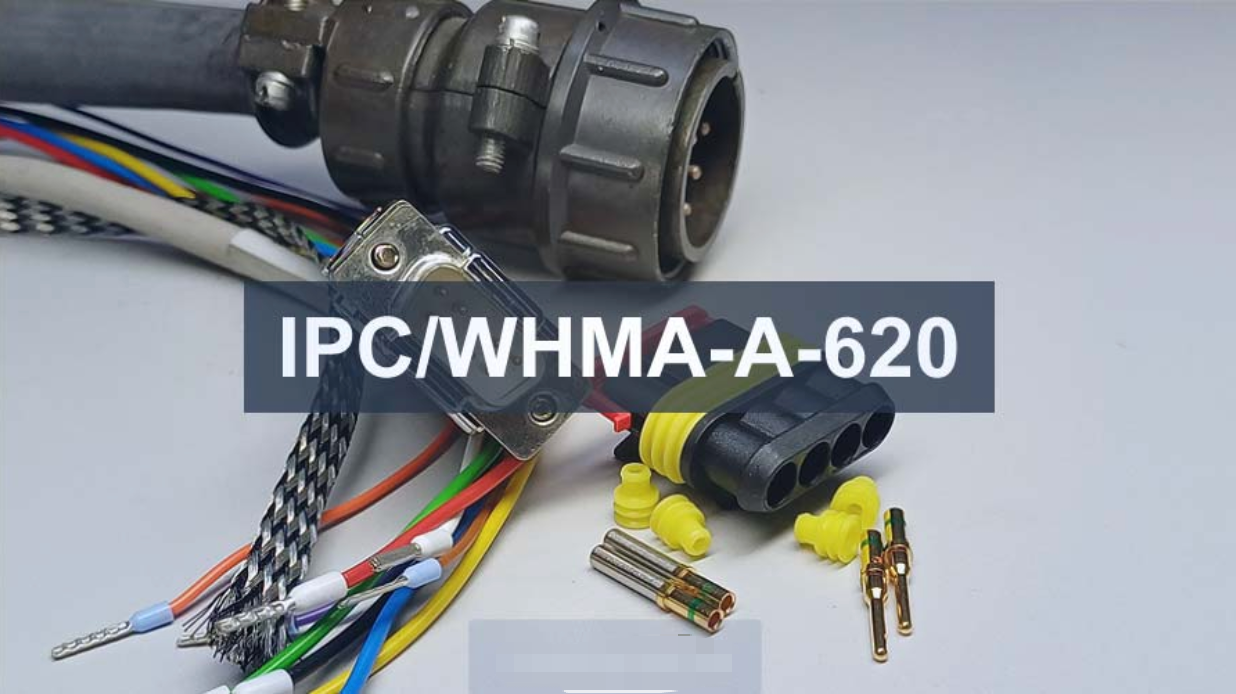
What Is IPC/WHMA-A-620?
IPC/WHMA-A-620 is the industry standard that defines materials, methods, inspections, and acceptance criteria for cable and wire harness assemblies. It covers key workmanship areas such as conductor preparation, crimping, soldering, insulation support, marking, and final assembly.
Unlike general quality guidelines, IPC/WHMA-A-620 provides objective, visual, and measurable criteria, enabling consistent interpretation across engineering, production, and quality inspection teams.
Why IPC/WHMA-A-620 Matters to Engineers
1. Clear Acceptance Criteria
Engineers rely on IPC/WHMA-A-620 to eliminate ambiguity in workmanship requirements. By defining acceptable, process indicator, and defect conditions, the standard ensures that assemblies are evaluated consistently throughout the product lifecycle.
2. Improved Design for Manufacturability
Designing with IPC/WHMA-A-620 in mind helps engineers avoid features that are difficult or unreliable to manufacture. This results in more robust designs, higher yields, and fewer corrective actions during production.
3. Reduced Risk in Mission-Critical Applications
For aerospace, defense, medical, and other regulated industries, workmanship failures can lead to system-level risks. IPC/WHMA-A-620 compliance reduces the likelihood of latent defects that may not be detected by functional testing alone.
Manufacturing and Quality Benefits
Process Control and Repeatability
IPC/WHMA-A-620 emphasizes controlled processes, proper tooling, and operator training. These requirements help manufacturers achieve repeatable results, especially in low-volume, high-mix environments.
Inspection and Traceability
The standard supports structured inspection procedures and documentation, improving traceability and audit readiness. This is particularly important when assemblies are part of regulated or government-supported programs.
Alignment Across Teams
IPC/WHMA-A-620 creates alignment between engineering, production, and quality by establishing a shared set of expectations. This reduces miscommunication and accelerates issue resolution.
IPC/WHMA-A-620 in Regulated Industries
In industries such as aerospace & defense, medical devices, industrial automation, and telecommunications, IPC/WHMA-A-620 is often required or strongly recommended. It complements broader quality systems such as AS9100 and ISO9001 by focusing specifically on cable and wire harness workmanship.
TRS Approach to IPC/WHMA-A-620 Compliance
At TRS, IPC/WHMA-A-620 is fully integrated into our cable assembly and wire harness manufacturing processes. Our teams are trained to the standard, and our procedures are executed within an AS9100- and ISO9001-compliant quality management system, ensuring consistency, traceability, and repeatable performance.
By applying IPC/WHMA-A-620 throughout design support, production, and inspection, TRS helps ensure that every assembly meets defined workmanship requirements and performs reliably in its intended application.
Conclusion
IPC/WHMA-A-620 compliance is not simply a quality checkbox—it is a foundation for reliable cable assembly manufacturing. For engineers and OEMs, it provides confidence that assemblies are built to a consistent, verifiable standard, reducing risk and improving long-term product performance.